
Trusted quality products
When we say trusted quality products, we are describing the internal procedures we use to assess quality, the improvement activities we carry out, and the initiatives presented on this page.
Our products follow structured testing processes specific to each product category, including supplier tests before shipment and additional inspections and spot checks at our distribution centres. These steps help us verify that products meet our defined safety and performance requirements. We also work with product design and durability as part of our continuous quality efforts.
Over the years, we have carried out systematic activities to strengthen product quality, and we continue building on these processes as part of our ongoing work.
At the product level, our key focus points are:
- Materials, certifications and product initiatives
- Product footprint calculations
- Quality and tests
Materials and initiatives
Material certifications
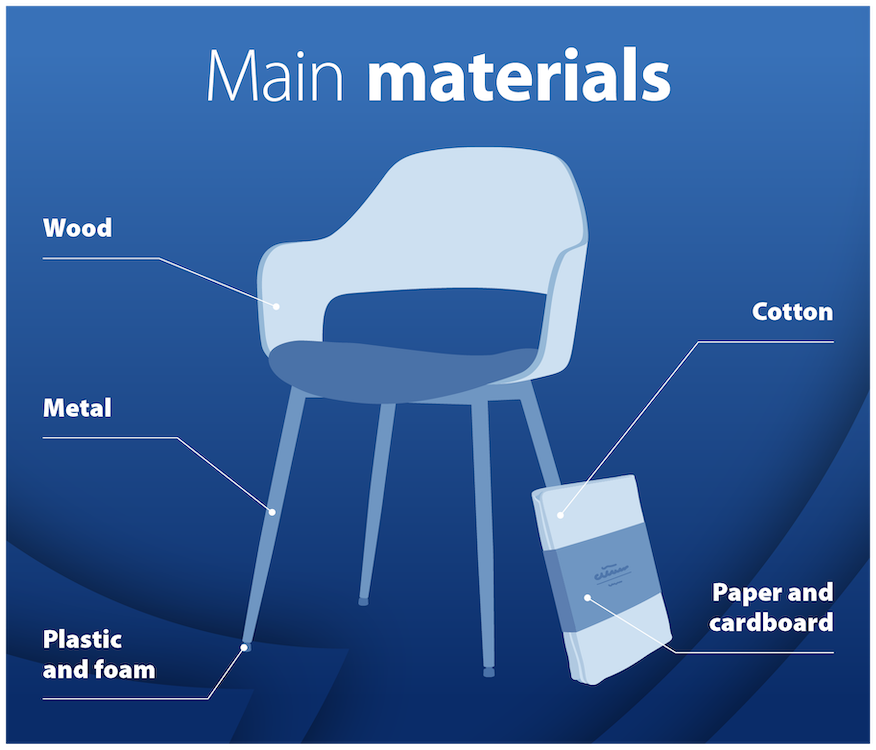
We want to ensure that selected material groups are certified according to relevant standards.
Therefore, we work on extending relevant certifications to all applicable products across our assortment. We have ambitious targets, that applies to selected key material groups for certifications and memberships. These apply to wood-based products and textiles, including cotton. We are proud of the progress we have made over the years, and of reaching one of our targets in FY25.
Certifications and memberships
We work with certifications and memberships at product level. You can read more about our partnerships with these organisations and how we work with the certificates here and in our annual report.
Forest Stewardship Council™
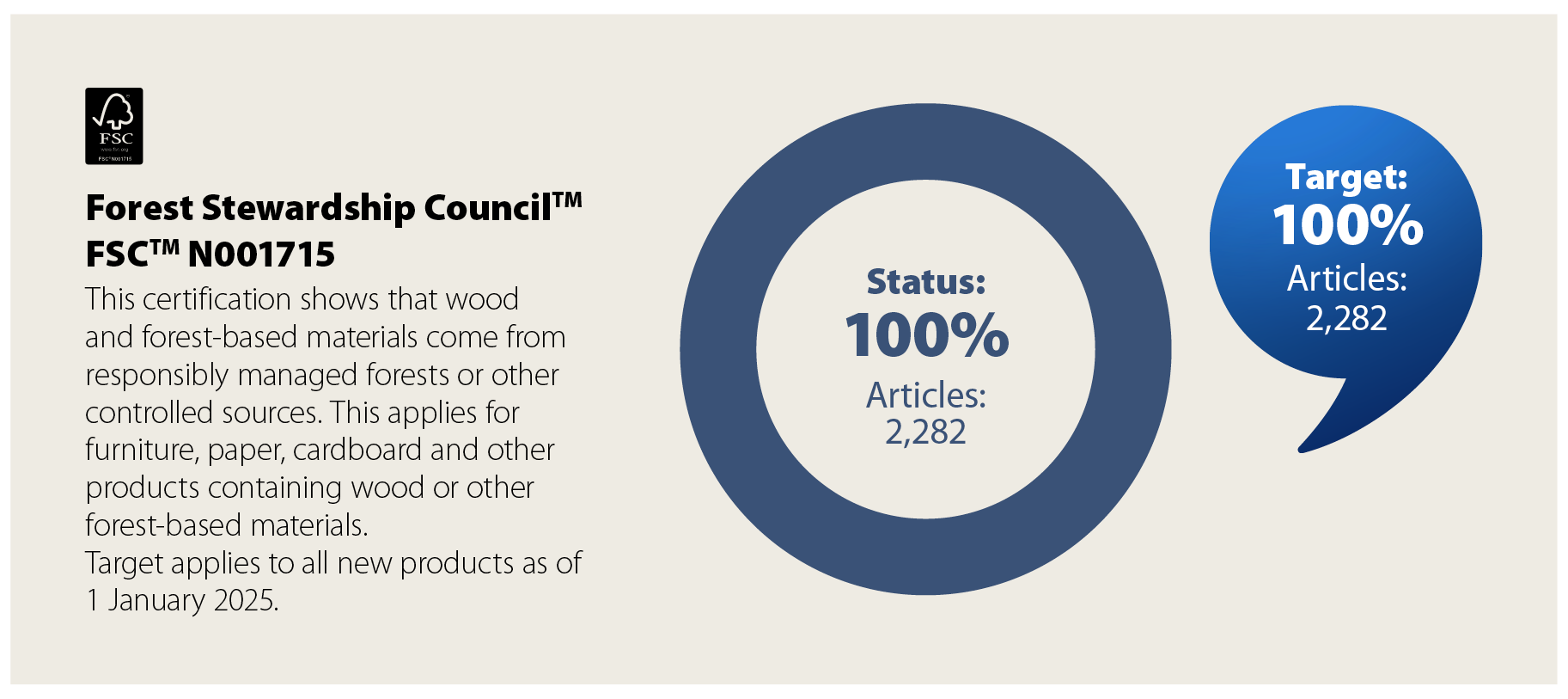
Forest Stewardship Council™ (FSC™) is a non-profit organisation and labelling scheme on a mission to ensure healthy, resilient forests around the world. For more than 30 years the FSC-label has ensured that the wood, paper, and other forest-based material used within a product is sourced from responsibly managed forests that preserves biological diversity, protects endangered species, and benefits the lives of local people and workers’ rights and safety.
As the only scheme of its kind, FSC gives democratic and equal influence and voting power between businesses, environmental NGOs, and social NGOs. The FSC certification scheme is trusted worldwide by businesses and consumers and recommended by leading environmental organisations like the WWF. Furthermore, FSC is working with indigenous people to collectively find solutions to environmental and social challenges in the world's forests.
JYSK has been a member of FSC Denmark since 2006. Since January 2025, all newly sourced products made from wood, cardboard, or paper are FSC certified (FSC™ N001715).
Find out more about FSC™ at fsc.org >
OEKO-TEX® STANDARD 100
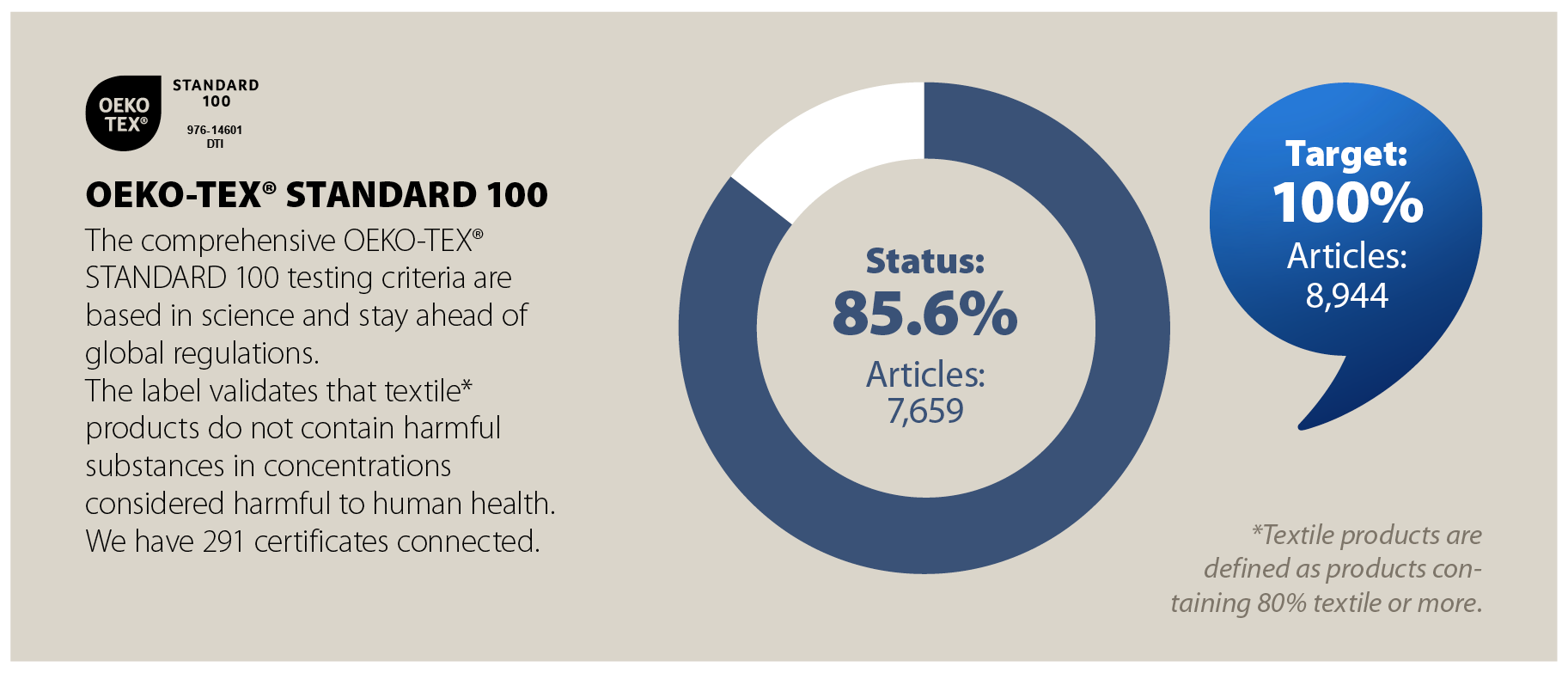
OEKO-TEX® is a label for textiles tested for harmful substances and sets the standard for textile safety, from yarn to finished product. OEKO-TEX® STANDARD 100 is an assurance for both JYSK and our customers that products bearing the label are certified to have passed safety tests for the presence of harmful substances, making them harmless to human health. Products with this label have been tested for more than 1000 potentially harmful substances.
The majority of JYSK's textile products are certified according to this standard. Specifically, it applies to all items where at least 80% of the weight consists of textile fibres. OEKO-TEX® STANDARD 100 label is also found on other products, such as the main components of our duvets and pillows. JYSK is certified under OEKO-TEX (976-14601).
When a product displays the OEKO-TEX® STANDARD 100 label, it indicates that the entire item, including non-textile components like zippers, buttons, and accessories, has been tested for harmful chemicals by independent OEKO-TEX® partner institutions.
Find out more at oeko-tex.com >
Better Cotton Initiative (BCI™) Membership
We are a proud member of the Better Cotton Initiative (BCI™), whose mission is to improve cotton farming globally.
We are committed to contribute to the improvement of cotton farming practices globally through our membership in the Better Cotton Initiative (BCI™).
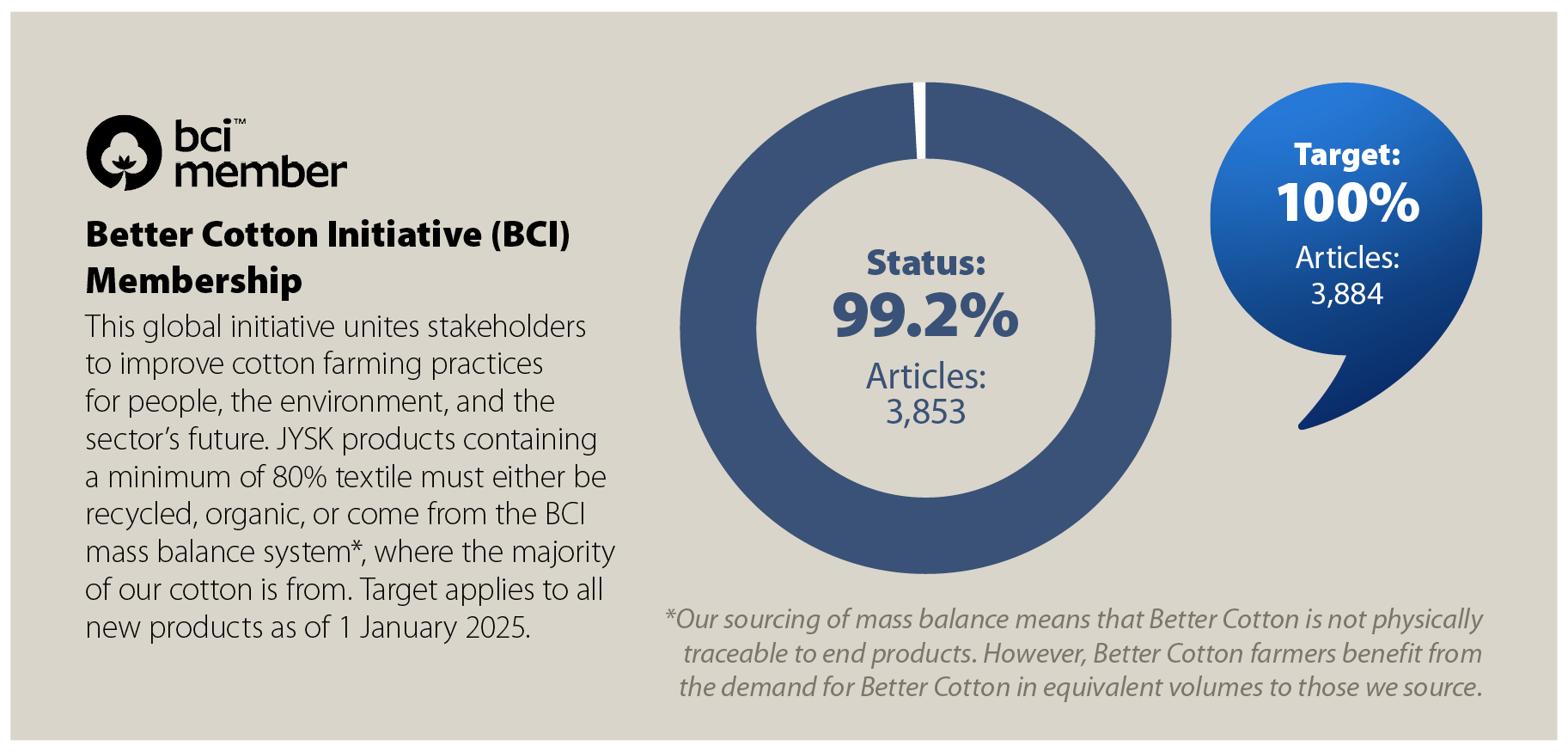
BCI Cotton is sourced via a chain of custody model called mass balance. This means that BCI Cotton is not physically traceable to end products. However, BCI farmers benefit from the demand for BCI Cotton in equivalent volumes to those we ‘source’.
Our target is that all JYSK products containing a minimum of 80% textile must either be recycled, organic, or come from the BCI mass balance system, where the majority of our cotton is from. By the end of FY25, the amount was 99.2% of all JYSK products, and minor fluctuations will appear throughout the year.
Learn more at bettercotton.org >
Other product initiatives
In addition to our ongoing work with certified materials, we also explore different product initiatives through ongoing research and testing. We are dedicated to implementing product-specific initiatives that address relevant environmental and ethical considerations. Initiatives we work with include recycled materials, optimising packaging solutions, reducing plastic usage, and promoting animal welfare.
It is important to us, that the products we sell have correct information and labelling, so that our customers can make informed choices. Therefore, we also conduct internal checks to verify the results and validation of the materials.
Recycled materials
As part of our ongoing product development, we are working on increasing the share of products with recycled materials. This work is guided by internal targets and depends on material availability, quality requirements, and commercial feasibility, and we use recycled materials in selected products across our assortment.
Recycled materials are materials derived from pre- or post-consumer waste that have been processed and reintroduced into new products.
When working with recycled materials, information about this should be part of the product information available to the customers. Therefore, we use certifications or transaction certificates (TC) from our suppliers, every time we receive an order with products containing recycled materials. This helps ensure the labels show correct and verified information.
This also means, the product suppliers are responsible for getting the products certified from a third-party organisation, as proof of the recycled content claim. Therefore, whenever a product is labelled as recycled, the claim is verified by a third party.
Packaging
Packaging is important for protection of the products during transportation. Our ongoing improvements have not only decreased the overall amount of packaging, including plastic, but have also optimised space in shipping containers. We are dedicated to use recyclable materials in our packaging where technically feasible.
While we already made progress, we remain committed to further reducing the materials used for packaging. This is done by continuously updating our packaging materials and designs and incorporating more responsible options across our product range.
For several product categories, we already transitioned from plastic packaging to FSC™-certified (FSC™ N001715) cardboard belly bands, aligning with our goal to minimise plastic consumption.
Our latest initiative implemented in 2026 is the transition from plastic hangers for shower curtains to FSC™ certified cardboard hangers. This initiative alone is estimated to save more than 10,000 kg of plastic per year.
We are constantly exploring ways to eliminate unnecessary plastic and packaging material in general without compromising functionality and protection and thinking recyclability into our solutions.
Animal welfare
We are committed to high animal welfare standards and do not tolerate animal cruelty. Our Animal Welfare Policy and Supplier Code of Conduct define our requirements for suppliers.
Duvets and pillows are core products for JYSK and often contain down and feathers. We strictly prohibit the use of materials sourced from live birds. To ensure compliance, we collaborate with the International Down and Feather Laboratory (IDFL), which audits the supply chain, including farms and abattoirs. Down and feathers used in our products are sourced exclusively as byproducts of the food industry.
JYSK also offers a limited selection of animal skins, which are sourced only from slaughtered animals and never from animals raised or killed solely for their skins. For wool products, we categorically reject the practice of mulesing, as stated in our Supplier Code of Conduct.
Product footprint
At JYSK, we recognise the importance of considering the full lifecycle of our products, including durability, disassembly, recycling, and end-of-life options.
For many years, we have focused on improving product durability through robust quality testing and continuous data evaluation. By prioritising durable products, we aim to extend their lifespan and reduce the need for frequent replacement.
From FY15 to FY25 we have successfully decreased the number of customer claims across all products with 67%, which is an indicator of improved product durability. More information about this can be found in our annual report.
We also help customers extend the life of their products by providing maintenance guidance and offering more than 4,000 spare parts for selected products free of charge.
Going forward, we will increase our focus on integrating end-of-life considerations into the design phase, recognising that design decisions significantly influence lifecycle emissions and our overall product footprint.
Calculating the carbon footprint of our products
One of our biggest impacts comes from our products, which is why calculating the carbon footprint of our products is important. This involves assessing the total climate impact emitted throughout a product's lifecycle. We make calculations based on data from different databases and adhere to the European guidelines to perform these calculations.
JYSK has initiated the work of calculating the product footprint for selected items across various categories, estimating their associated CO2e emissions. However, we do not yet have this data for all products, which remains our goal. To achieve this, we are currently working on gathering the necessary data that will allow us to calculate the footprint for all our products. This is a time-consuming task, as we need comprehensive data from all suppliers. These data include, among other factors:
- Materials used
- Weight of each material
- Country of origin for materials
- Country of origin for production
- Production processes
In the long term, we aim to develop an internal scoring system for our products from a sustainability perspective. By leveraging various data insights, we will gain a clearer understanding of which of our products have the most significant environmental impact. This information will guide our product decisions and help us establish clear standards to inform and guide our choices moving forward.
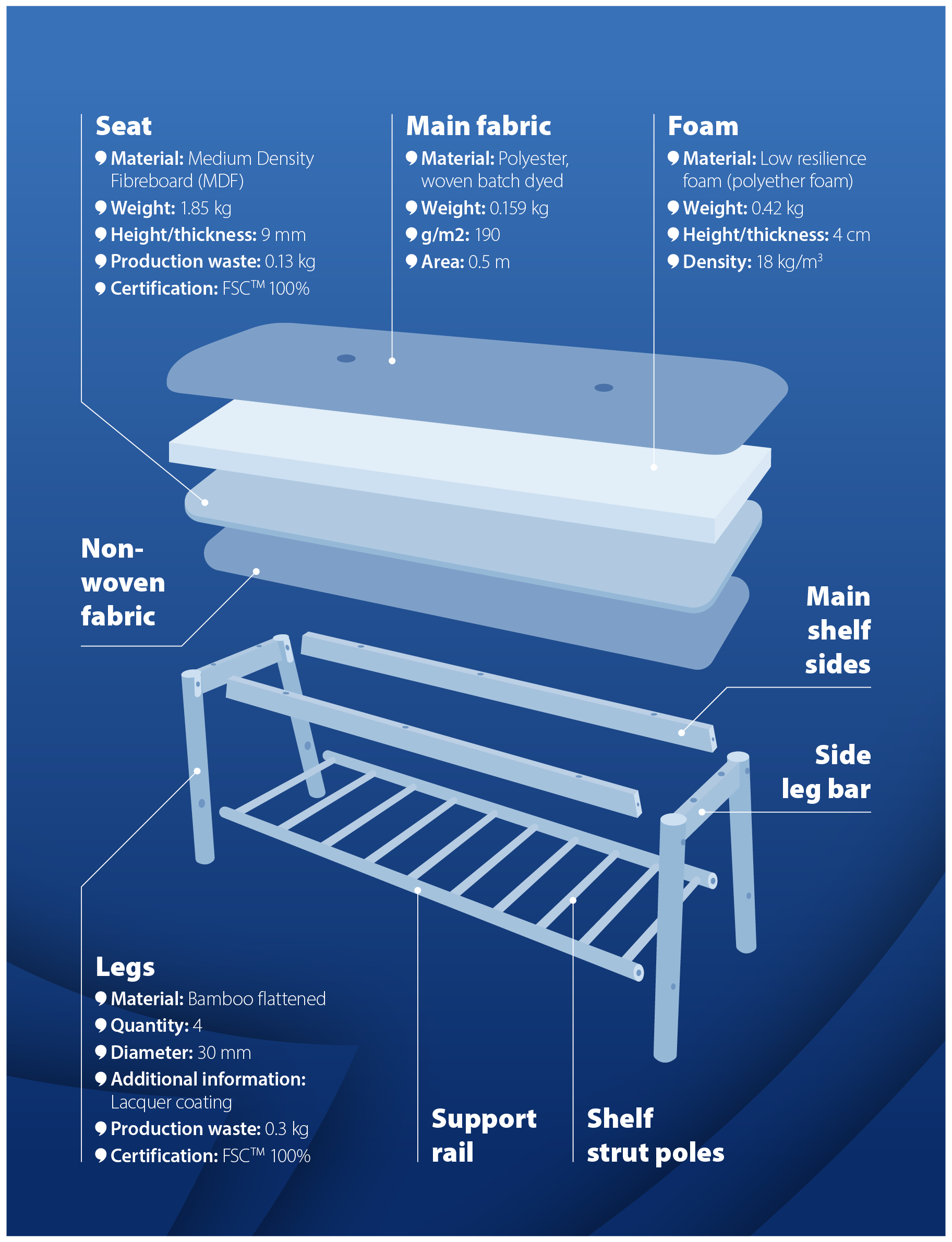
The illustration shows how we will dive into product materials with an example of an exploded view of a product, where we zoom in on selected key data points.
Quality and tests
At JYSK, ensuring that our products meet high standards of quality and safety is of utmost importance. We carefully select our suppliers and regularly have our purchasers and quality staff visit selected factories to assess product quality.
When the products arrive at our warehouses, random checks are made. This includes random samples from the product shipments, which then undergo additional checks by JYSK Quality Control before being distributed to our stores.
Quality test process

Discover how our commitment to quality is embodied in our products by watching the video below.
Tested for harmful chemicals
We prioritise reducing and restricting harmful chemicals from our products. To ensure compliance, we set strict requirements for our suppliers, who must conduct tests and provide documentation confirming that our standards are met. The reach regulation is 0.1% w/w.
Substances of Very High Concern (SVHC) pose potential risks to health and the environment. At JYSK, we generally prohibit use in our products, with limited exceptions for lithium batteries, certain electrical items where alternatives are not yet available, and fire retardants in foam products for the British Isles where required by law.
The EU regularly updates the SVHC list. When new substances are added, we inform our suppliers and require them to phase these out within six months. We also collaborate with external laboratories to test products for harmful chemicals and conduct random quality checks at our distribution centres.
Documents and declarations
Consumer Data Sheets
In accordance with EU Regulation No. 648/2004, we publish the list of ingredients for detergents.
You can find the full list here >
Declarations of Conformity
We have gathered an overview of our declarations of conformity.
You can find the full list of declarations of conformity here >
Unsold products
In accordance to EU Ecodesign for Sustainable Products Regulation (ESPR) here is our report of unsold products.