
Climate action
We work to reduce the impact our business has on the climate and the environment. We consider this a fundamental responsibility, and we are committed to reducing CO2e emissions in our own operations and value chain, in line with the Paris Agreement goal of limiting global warming to 1.5°C compared to preindustrial levels.
To support this, we joined the Science Based Targets initiative (SBTi) and had our targets verified in 2024, with a baseline for our emissions using data from our financial year 2022 (FY22).
This marked a key step in our sustainability journey and is an essential part of delivering on our sustainability strategy and our climate ambitions.
More information about the SBTi and scope 1, 2, and 3 can be found below.
Targets
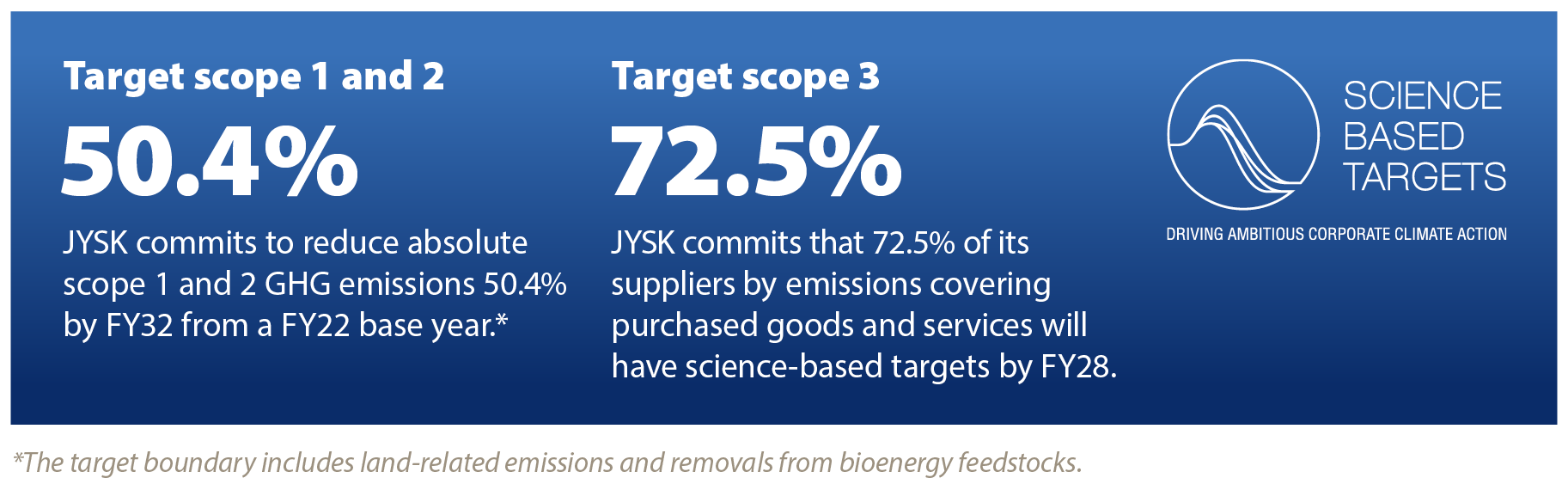
We have set ambitious targets to reduce greenhouse gas emissions across both our operations and our supply chain and prioritise actions that support these efforts. Read more about progress, methodology, and calculations in our climate accounting document >
How we take action
We work with prioritised initiatives designed to help us achieve our targeted reductions across scope 1, 2, and 3. We track our emissions and aim to reduce the average emissions per product and per store.
Scope 1 and 2 – Own operations
Overall, our market-based scope 1 and 2 emissions have declined by 1.2% from FY22 to FY25, primarily reflecting changes in energy consumption across our own operations.
With a strong focus on store performance, we achieved a 9% reduction in emissions per store between FY22 and FY25.
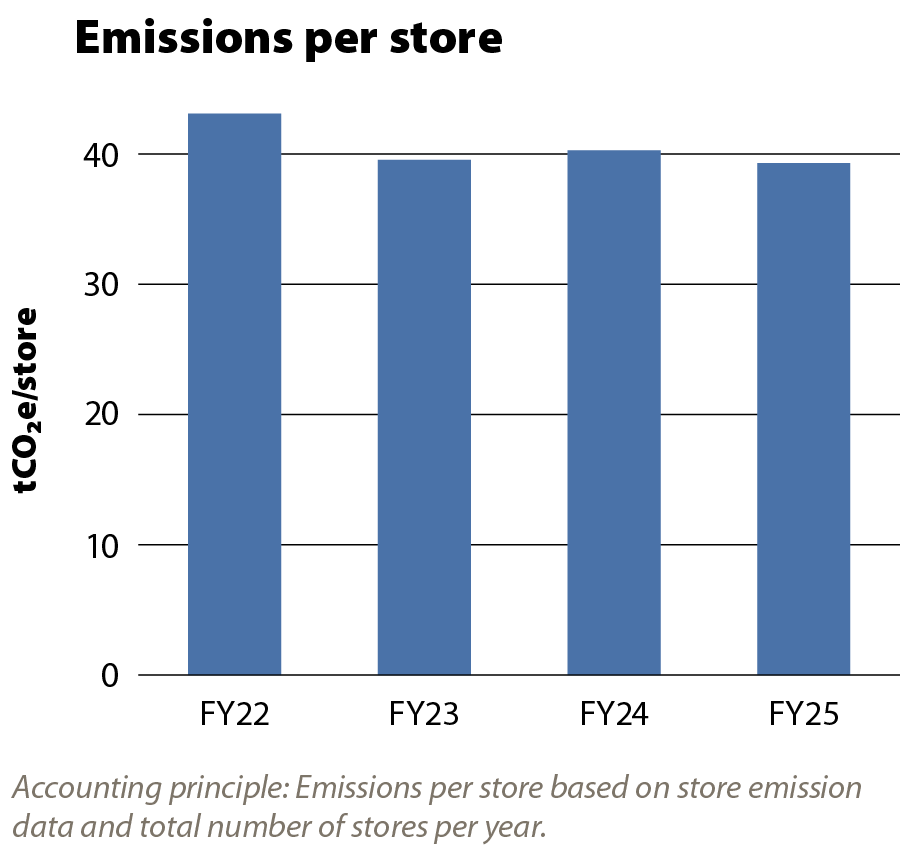
This progress, achieved alongside continued business expansion, indicates that we are moving towards decoupling emissions growth from the increase in store numbers.
We are implementing a range of initiatives to support the achievement of our scope 1 and 2 target of a 50.4% absolute reduction. In FY26, we also obtained limited assurance on our climate transition plan for scope 1 and 2.
More on this can be found in our annual report > and in our climate transition plan for scope 1 and 2 >
Scope 3 - SBTi supplier engagement target
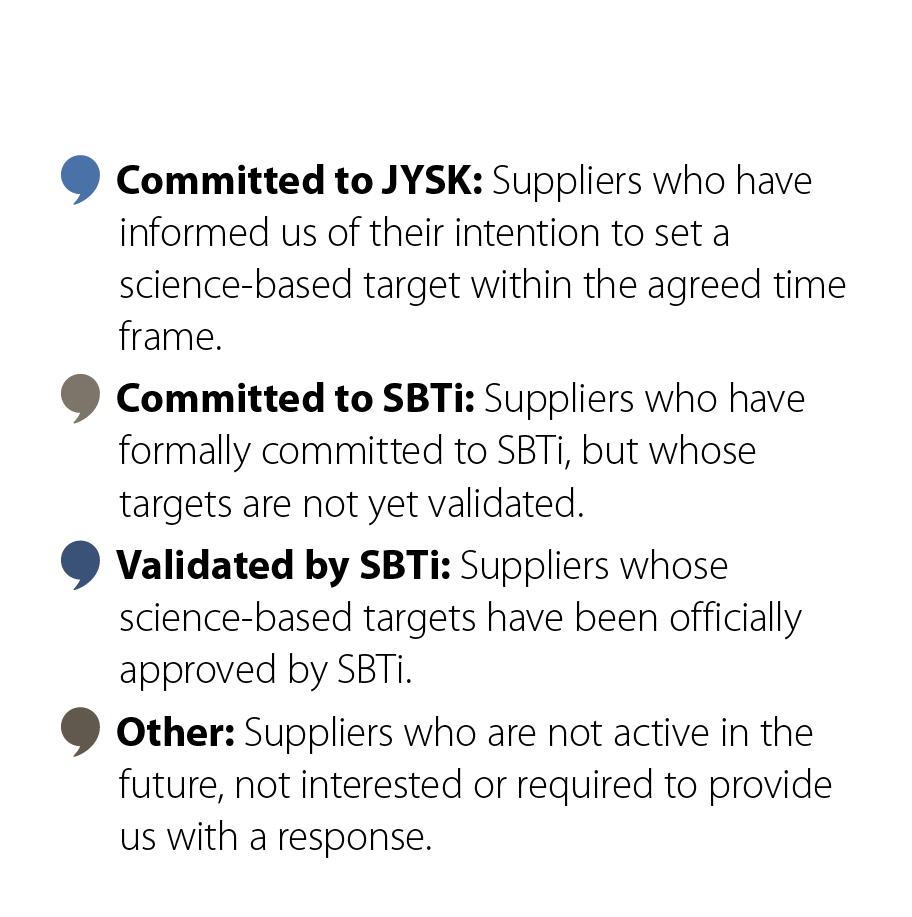
Purchased goods and services represent the largest share of our scope 3 emissions. To address this, we established an SBTi-validated supplier engagement target, encouraging suppliers to set their own science-based targets.
By FY28, we aim for 72.5% of our suppliers - measured by emissions within purchased goods and services - to have science-based targets in place.
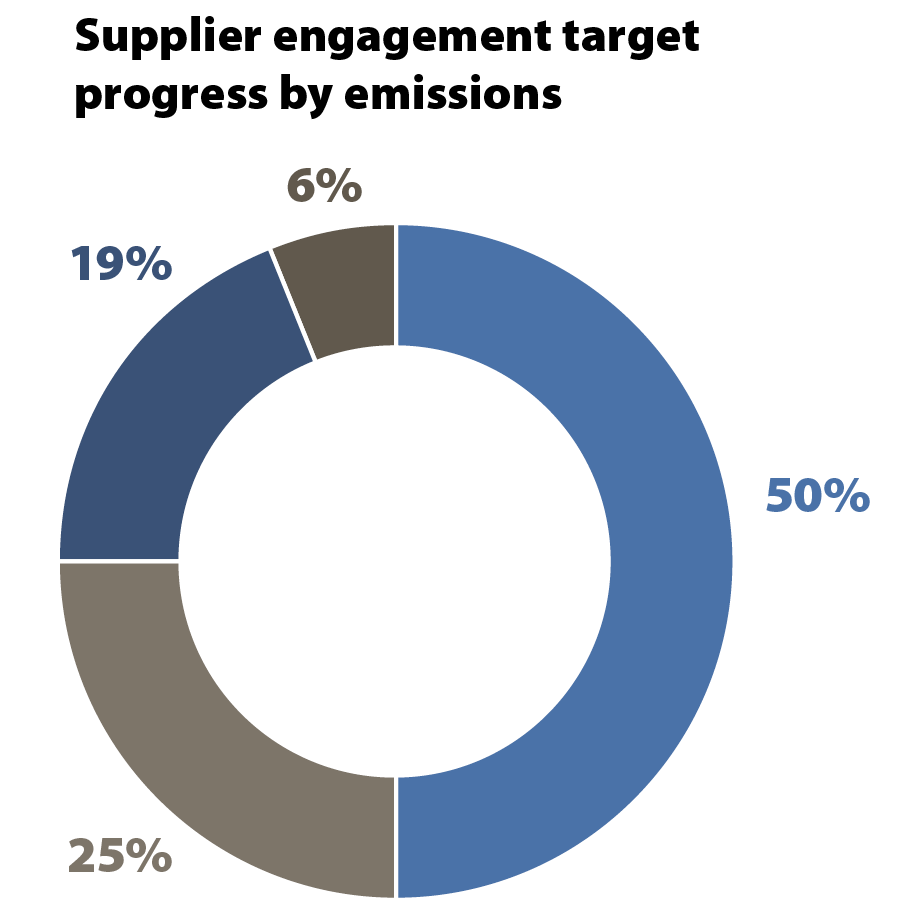
We are proud that, as of FY25, 19% of our product suppliers have a validated science-based target and 25% are committed to setting science-based targets. Read more about our actions and progress in our annual report >
Science Based Targets initiative (SBTi)
The Science Based Targets initiative (SBTi) is an initiative that provides a framework for companies to set emission reduction targets that align with the latest climate science. Targets are considered science-based if they are consistent with the goals of the Paris Agreement, which aims to limit global warming to well below 2°C above pre-industrial levels and pursue efforts to restrict it to 1.5°C.
SBTi focuses on emissions across three categories: Scope 1, 2, and 3. These scopes classify greenhouse gas emissions generated by JYSK directly (Scope 1), indirectly through energy consumption (Scope 2), and through our supply chain and customer activities (Scope 3). Each of these scopes presents unique challenges and opportunities that call for direct action in our operations, supplier engagement, or investments in new technologies.
Our SBTi targets cover JYSK’s own operations (Scope 1 and 2) and relevant upstream and downstream value chain activities (Scope 3), based on FY22 emissions data.
Scope 1, 2 and 3
In climate accounting, greenhouse gas emissions are categorised into three scopes, each representing specific types of emission.
Scope 1
Scope 1 refers to direct emissions from JYSK's own operations. These are emissions that come from sources we control, such as fuel combustion in company vehicles. This is the scope where JYSK has the highest level of operational control, as we have full control over the data sources used to calculate these emissions. Because of this, emissions are generally easier to monitor and reduce within this scope.
Scope 2
Scope 2 covers indirect emissions from the production of energy consumed by JYSK at our own sites. This includes emissions from generating electricity, heating, or cooling that we use in our operations. These emissions are a consequence of JYSK’s energy demand. Emissions within this scope can be tracked and calculated based on invoices received from our energy suppliers.
Scope 3
Scope 3 includes all other indirect emissions that JYSK is responsible for, occurring throughout our value chain. This encompasses emissions from the production and transportation of our products, as well as emissions generated when customers use our products. As Scope 3 covers both upstream and downstream emissions, from suppliers to end-users, it is a particularly broad and complex category to address.
Want to know more?
If you would like to know more about our climate accounting, please reach out to: sustainabilityteam@JYSK.com.